

Impact of Excessive Noise on Surgical Team Performance in the Operating Room
The operating theatre is a complex environment that requires precise communication among multi-disciplinary teams. Surgeons, anaesthetists, nurses and technicians must exchange critical information efficiently to ensure patient safety. Noise is a consistent issue in the operating room, originating from a combination of equipment, alarms, environmental systems and people. Even when staff are highly trained, excessive noise can disrupt spoken communication, reduce situational awareness and increase the likelihood of errors during critical moments.
In addition to affecting speech clarity, background noise can increase cognitive load, stress levels and fatigue for surgical teams. This can influence decision-making, procedural timing, and coordination among team members. Understanding the sources and effects of noise, as well as the importance of monitoring it, is essential for improving communication, maintaining team efficiency, and safeguarding patient outcomes. Monitoring strategies also provide the opportunity to identify specific periods or locations within the operating room where noise may interfere with critical communication, particularly near the patient where verbal instructions and cues are concentrated.
This white paper explores the effects of noise on surgical team communication and outlines recommendations for monitoring noise to support effective communication in the operating room.
Impact on surgical team communication
Noise in the operating room can come from many sources, including powered surgical instruments, alarms and monitors, HVAC systems, music and staff conversations. Peak events can exceed 90–100 dB(A), which significantly disrupts verbal communication and situational awareness.
Clear verbal communication is fundamental to effective teamwork in the operating room.
Brandon Medical White Paper Research indicates that when background noise is high, speech intelligibility begins to deteriorate significantly, making it difficult for team members to hear and accurately interpret spoken instructions.
Excessive noise in the operating room not only reduces speech clarity but also increases the incidence of communication errors. High noise conditions lead to repeated instructions, misheard commands and delayed responses among team members. For example, a surgeon issuing critical instructions during an alarm event may find that the anaesthetist or scrub nurse requires repetition, introducing delays that can disrupt workflow. These communication breakdowns can be particularly pronounced during multi-disciplinary procedures or when multiple conversations overlap.
In a review [1] of ten studies on the impact of noise in the operating theatre, eight found noise to be detrimental to communication and surgical performance, particularly regarding total errors and task completion time. None of the studies found noise to be beneficial. Two studies found case-irrelevant verbal communication to be a frequent form of noise pollution in operating theatres; this was perceived by surgeons to be distracting and to cause delays in patient care. The review concluded that noise and irrelevant verbal communications were found to be harmful to surgical performance and team functioning.
Further studies [2,3,4] have found that loud and unnecessary environmental noises can be distracting to a surgeon.
Does music help or hinder?
A systematic review [5] of the influence of music on the surgical task performance found that in many cases music can have a positive effect. In particular, classical music when played with a low to medium volume can improve the surgical task performance by increasing both accuracy and speed. However, the distracting effect of music should be considered when played at loud volumes or with fast tempo.
A UK study in 2012-2013 [6] made video recordings of 20 operations over six months in two operating theatres. The recordings were divided into music and non-music playing cases and the effectiveness of request interactions between team members were analysed.
The resulting analysis revealed that repeated requests were five times more likely to occur in cases that played music than those that did not. A repeated request can add 4-68 seconds each to operation time and increased tensions due to frustrations with ineffective communication.
However, there are mixed opinions amongst surgical teams about the benefits or otherwise of playing music during surgical procedures. This mixed opinion is seen again in a survey of surgical staff in New Zealand in 2014 [7]. A hundred and six responses were received. 98% of people said that music is played in their operating rooms, with 50% saying it was played more than 50% of the time. 60% liked having it, whereas 30% disliked it. Easy Listening was the genre most played closely followed by Pop and Classical. Easy Listening was the most preferred and classical music the second most. Music was preferred for longer, more familiar and non-urgent procedures, at a low to medium volume, though 84% felt it was a distraction in a crisis situation. Most respondents felt music improved calmness, overall mood, overall team performance and surgeon’s performance, although it did affect communication.
In a similar sized survey in South Africa in 2023 [8] most respondents reported that background music in the operating room improved temperament, focus, mood, and performance, though over a quarter felt it worsened communication.
It is clear from the number of published papers on the subject that while there are perceived benefits from playing music in the operating room there are also concerns around the distracting effect when played at loud volumes.
Impact on surgical team stress
Noise acts as a cognitive stressor, degrading attention and situational awareness. Elevated background sound increases mental workload, reduces working memory capacity and can heighten stress responses among surgeons, anaesthetists and nursing staff.
A study of the detrimental effects of operating room noise [9] found that it reduced the mental efficiency and short-term memory of anaesthesia residents.
A further study [10] with twenty anaesthesiologists engaged in an operating room simulation provided evidence that noise during surgery can increase feelings of stress, as measured by perceived task load and fatigue levels.
These laboratory simulations and field studies demonstrate that excessive noise increased stress levels, which can in turn lead to slower response times and more frequent task errors, especially during procedures requiring precision and rapid decision-making.
Patient safety implications
While causality is difficult to establish, excessive operating room noise can be expected to present risks for patient safety. Miscommunication under noisy conditions could cause errors in drug delivery, instrument handling and coordination of critical procedural steps. Noise levels should be treated as an environmental risk factor in the perioperative setting, with monitoring and mitigation strategies aimed at preserving clear communication and optimal team performance.
International guidelines for noise
International guidance provides multiple reference points for managing noise. Although each framework has a slightly different purpose, they are generally focussed on occupational health efforts to protect hearing, rather than the effects on efficient communication.
The World Health Organization (WHO) recommends continuous noise levels below 35 dB in hospital treatment areas [11]. This target is primarily based on patient comfort.
In the United States, the Environmental Protection Agency (EPA) advises that hospitals maintain average noise levels below 45 dB(A) over a 24-hour period to support patient comfort and facilitate clear communication [12]. Although the EPA’s guidance is not regulatory, it is frequently referenced in facility design and improvement initiatives.
The USA Occupational Safety and Health Administration (OSHA) provides enforceable limits for occupational noise exposure (85–90 dBA over an 8-hour period) with the primary goal of preventing hearing loss [13].
In Europe, Directive 2003/10/EC sets occupational exposure limits for noise in hospitals to protect workers’ hearing [14]. Employers must assess noise, implement controls when exposure exceeds 85 dB(A), and prevent peaks above 140 dB(C). Although these thresholds are not designed for communication optimization, they provide an upper bound for OR noise and a regulatory context for continuous monitoring programs.
In the UK, the Health and Safety Executive (HSE) mirrors EU directives but integrates human factors guidance for NHS operating rooms, encouraging consideration of noise as a factor affecting teamwork, situational awareness, and patient safety [15,16].
Practical solutions
As noise in the operating room has been identified as a significant issue, companies such as Silent High Tech Solutions GmbH, are trying to deliver solutions. Their SOTOS product consists of headsets worn by the surgical team that plays automatically adapting music to mask the residual noise level. This quiet listening environment automatically allows interruptions from information and important signals necessary for their work.
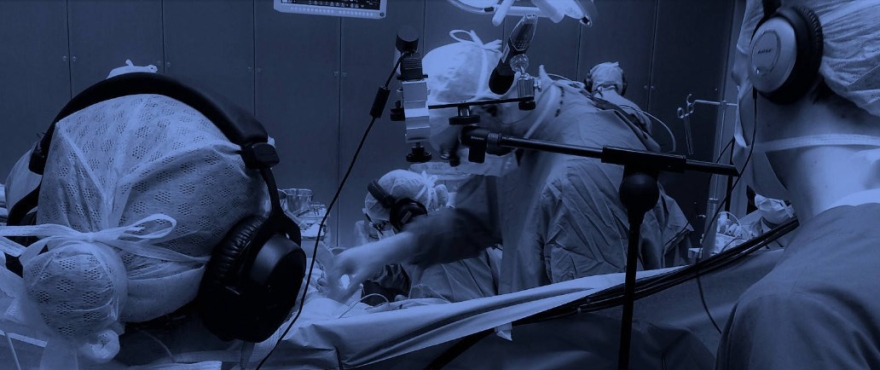
SOTOS system deployed during a procedure to mitigate the effects of background noise.
It is debatable whether the SOTOS system provides a practical solution to the issues associated with noise in the operating room.
A more practical approach is to monitor noise so that preventative strategies can be developed.
Benefits of noise monitoring for surgical teams
Continuous noise monitoring in the operating room offers substantial benefits for team communication and performance. By capturing noise levels in real-time, monitoring systems can provide objective data on periods when verbal instructions may be difficult to hear or misinterpreted. This data can be used by the hospital in a hierarchy of implementation levels:
- local communication to the surgical team,
- automated equipment responses,
- big data analyses.
Level 1 – Local communication
Local display and visible alarms can be used to inform the surgical team of high noise levels. This information enables teams to implement targeted interventions, such as adjusting alarm volumes, reorganizing equipment placement, reducing music volume or modifying staff movement and conversation patterns.
Level 2 – Automated equipment responses
If noise data can be made available to local control equipment, such as theatre control panels, it is possible to form closed loop control systems. These systems can be used to automatically reduce music volumes in response to high ambient noise levels.
Level 3 – Big data analyses
Once noise data is available to hospital management it can be combined with patient outcome and procedural efficiency data. This combined data analysis can be used to optimise surgical procedures. By sharing data with surgical teams, staff can gain insight into environmental conditions that impair communication and can adjust their behaviour accordingly. For example, implementing “quiet zones” during critical procedural phases or establishing standardized verbal protocols can reduce misunderstandings and delays.
Furthermore, noise monitoring can be used to inform long-term quality improvement and facility design decisions. Operating room layouts, ventilation systems, and equipment positioning can be optimized using data from noise measurements to minimize background sound and transient peaks that disrupt team interactions.
Noise Measurement – practical steps
Where to measure?
The area around the patient is the central hub for verbal interaction between the surgeon, anaesthetist, and critical support staff. Excessive noise here can directly impede the clear exchange of instructions, particularly when immediate responses are required for medication administration, airway management, or emergency interventions. For this reason, the optimal location for noise monitoring is in the area near to the patient.
What to measure?
There are several measures of sound level, with two of the most common being dB (SPL) and dB(A).
dB SPL (Sound Pressure Level) measures the raw physical intensity of sound relative to a reference of 20 μPa in air. It treats all frequencies equally – a given sound pressure at 100 Hz counts the same as at 1 kHz.
dBA (A-weighted decibels) is a frequency-weighted version of dB(SPL) intended to approximate the human ear’s sensitivity to perceived loudness at moderate levels – mid-frequencies (around ~1 kHz–5 kHz) are weighted more heavily, and low/high frequencies are attenuated. Because A-weighting de-emphasizes low frequencies, dB(A) measurements do not represent all spectral energy equally.
dB(A) is less well suited for assessing the ability to understand spoken communications as speech intelligibility depends on frequency content. Most speech information (especially consonants critical for intelligibility) is in the 500 Hz–4 kHz range. Noise in this range, even if lower in overall physical SPL, can still mask speech and reduce intelligibility. dB(A) approximates perceived loudness, not how noise interferes with speech cues.
Using unweighted dB(SPL) is beneficial as it ensures all frequencies are included equally in the measurement. This is important because even low-frequency energy can contribute to masking effects that make speech more difficult to hear than the dB(A) value indicates.
In general, dB(SPL) is a more appropriate measure when the concern is masking effects that make communication difficult, rather than just general loudness.
Alarm thresholds
The UK Department of Health memorandum on acoustics states that the criteria for internal noise from mechanical and electrical services in an operating theatre is NR40 [17]. Note that this excludes laminar flow theatres, where increased background noise can be expected.
Noise rating (NR) describes the maximum sound pressure level over a range of frequencies. A plot of NR40 shows that for the majority of frequency bands the sound pressure stays below 50 dB(SPL).
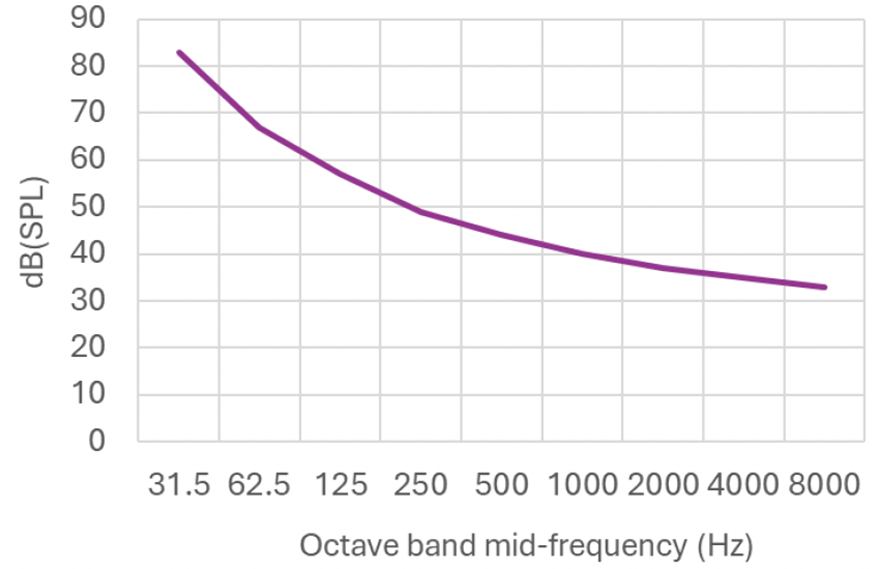
NR40 sound pressure level change with frequency [18]
A study of conversational speech levels in realistic acoustic conditions [19] found that acoustic background noise at above approximately 69 dB(SPL) at 1 m distance, or 75 dB(SPL) at 0.5 m impacted speech intelligibility.
The value selected for the alarm threshold will be dependent on the level of unavoidable background noise and this will be dependent on the surgical procedure. A procedure that uses bone cutting equipment will have a significantly higher level of background noise. It is advisable that the noise monitoring threshold is set at a fairly low level and is adjusted over time as the surgical team decides what is appropriate.
An alarm threshold of 75 dB(SPL) would be a reasonable start point. This threshold will not guarantee perfect speech intelligibility for all procedures and in all operating rooms but it will be an important first step in optimising the noise environment.
Conclusion
Excessive noise in the operating room often surpasses levels required for clear speech and is a critical factor affecting surgical team communication, coordination, and performance. Implementing continuous noise monitoring, particularly near the patient can enhance workflow efficiency, reduce cognitive load and support improved patient outcomes.
References
[1] Mcleod R, Myint-Wilks L, Davies SE, Elhassan HA. The impact of noise in the operating theatre: a review of the evidence. Ann R Coll Surg Engl. 2021 Feb;103(2):83-87. doi: 10.1308/rcsann.2020.7001. PMID: 33559553; PMCID: PMC9773860.
[2] Rogers CM, Palmerton H, Saway B, Tomlinson D, Simonds G. Effect of Various OR Noise on Fine Motor Skills, Cognition, and Mood. Surg Res Pract. 2019 Jul 4;2019:5372174. doi: 10.1155/2019/5372174. PMID: 31355326; PMCID: PMC6637681.
[3] Hasfeldt D, Laerkner E, Birkelund R. Noise in the operating room–what do we know? A review of the literature. J Perianesth Nurs. 2010 Dec;25(6):380-6. doi: 10.1016/j.jopan.2010.10.001. PMID: 21126668.
[4] Sarah Peisl, Daniel Sánchez-Taltavull, Hugo Guillen-Ramirez, Franziska Tschan, Norbert K Semmer, Martin Hübner, Nicolas Demartines, Simon G Wrann, Stefan Gutknecht, Markus Weber, Daniel Candinas, Guido Beldi, Sandra Keller, Noise in the operating room coincides with surgical difficulty, BJS Open, Volume 8, Issue 5, October 2024, zrae098,
[5] El Boghdady M, Ewalds-Kvist BM. The influence of music on the surgical task performance: A systematic review. Int J Surg. 2020 Jan;73:101-112. doi: 10.1016/j.ijsu.2019.11.012. Epub 2019 Nov 22. PMID: 31760139.
[6] Weldon SM, Korkiakangas T, Bezemer J, Kneebone R. Music and communication in the operating theatre. J Adv Nurs. 2015 Dec;71(12):2763-74. doi: 10.1111/jan.12744. Epub 2015 Aug 4. PMID: 26243722.
[7] Narayanan A, Gray AR. First, do no harmony: an examination of attitudes to music played in operating theatres. N Z Med J. 2018 Aug 17;131(1480):68-74. PMID: 30116067.
[8] Narayanan A, Naidoo M, Kong VY, Pearson L, Mani K, Fisher JP, Khashram M, Clarke DL. Broad responses and attitudes to having music in surgery (the BRAHMS study) – a South African perspective. S Afr J Surg. 2023 Mar;61(1):30-38. PMID: 37052283.
[9] Murthy VS, Malhotra SK, Bala I, Raghunathan M. Detrimental effects of noise on anaesthetists. Can J Anaesth. 1995 Jul;42(7):608-11. doi: 10.1007/BF03011878. PMID: 7553997.
[10] McNeer RR, Bennett CL, Dudaryk R. Intraoperative Noise Increases Perceived Task Load and Fatigue in Anesthesiology Residents: A Simulation-Based Study. Anesth Analg. 2016 Feb;122(2):512-25. doi: 10.1213/ANE.0000000000001067. PMID: 26797555.
[11] World Health Organization. Guidelines for Community Noise. WHO, 1999.
[12] US Environmental Protection Agency. Environmental Noise Requisite to Protect Public Health. 1974.
[13] OSHA. Occupational Noise Exposure (29 CFR 1910.95).
[14] European Parliament and Council. Directive 2003/10/EC on minimum health and safety requirements regarding exposure to physical agents (noise).
[15] UK Health and Safety Executive (HSE). Control of Noise at Work Regulations 2005.
[16] UK HSE. Noise at Work: A Brief Guide.
[17] Specialist services Health Technical Memorandum 08-01: Acoustics, UK Department of Health
[18] Data from Engineering Toolbox https://www.engineeringtoolbox.com/nr-noise-rating-d_60.html
[19] Adam Weisser, Jörg M. Buchholz, Conversational speech levels and signal-to-noise ratios in realistic acoustic conditions, January 2019The Journal of the Acoustical Society of America 145(1):349-360, DOI: 10.1121/1.5087567
Author
Tom Partington, Brandon Medical